A turning point for psychedelic medicine: what the 2026 executive order means for patients and providers
In April 2026, the federal government issued an executive order directing the FDA to accelerate approval of psychedelic-assisted therapies and issued priority review vouchers to three clinical-stage companies. These actions signal a meaningful shift toward the regulated medicalization of treatments like psilocybin, MDMA, and LSD for conditions including major depression, treatment-resistant depression, PTSD, and anxiety disorders — though FDA approval will still require rigorous Phase 3 clinical trial data. Psychedelic Science Institute (PSI) and its TRIP Clinics in Hollywood and Santa Monica have served as leaders in the research and delivery of psychedelic medicines
In late April 2026, the federal government signaled what may become a historic turning point in the treatment of mental illness. A presidential executive order focused on serious mental illness, combined with multiple FDA actions accelerating psychedelic drug development, suggests the United States may be entering a new era in behavioral healthcare — one in which psychedelic-assisted therapies (PAT) move from clinical trials into mainstream medicine. While these events do not legalize any psychedelic drugs, they represent a major federal shift, reducing regulatory barriers, signaling institutional support, and potentially accelerating the timeline of the first FDA approvals into late 2026 or 2027, provided Phase 3 trial data is convincing.
Regardless of the political and cultural forces converging around this pivotal moment, it has far-reaching implications for the field of psychedelic medicine and the broader behavioral neurosciences. PAT may ultimately become a major component of the rapidly evolving field of interventional psychiatry and neuroplasticity-based mental healthcare.
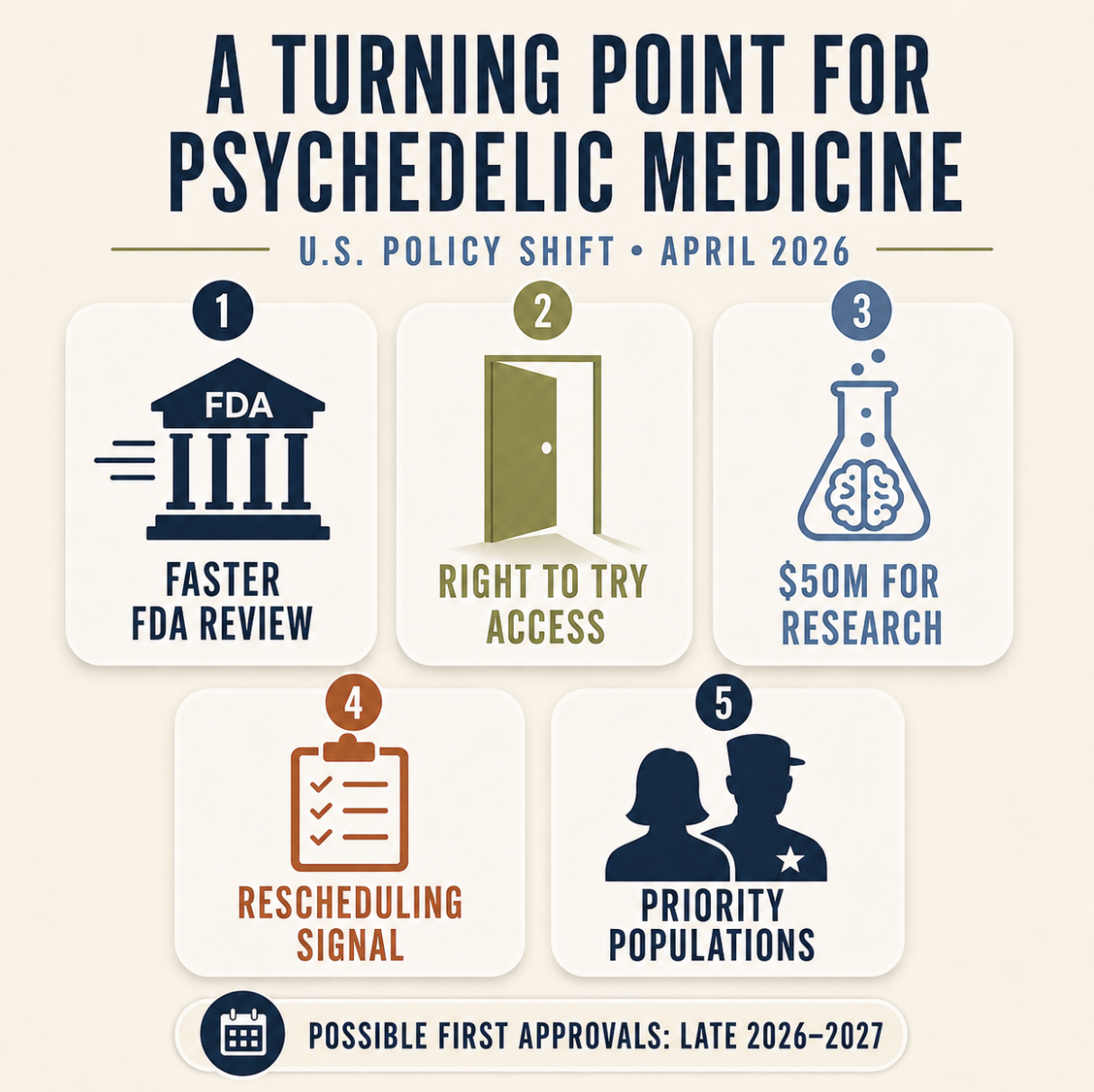
Key provisions of the executive order (April 18, 2026)
- Faster FDA approval: The order directs the FDA to expedite review of psychedelic drugs (psilocybin, LSD, MDMA, ibogaine) with breakthrough therapy pathways potentially accelerating regulatory review timelines.
- Expanded patient access (pre-approval): It enables earlier access through the Right to Try Act.
- Federal research funding: It allocates $50 million with an emphasis on ibogaine for PTSD, addiction, and TBI.
- Potential pathway toward rescheduling: It signals intent to rapidly reconsider Schedule I status following successful clinical trials, an essential step toward mainstream medical adoption.
- Priority populations: It places strong emphasis on high-need groups including veterans and severe mental health conditions like PTSD, treatment-resistant depression, and substance use disorders.
The three FDA priority review vouchers (April 24, 2026)
- Compass Pathways: psilocybin for treatment-resistant depression (TRD)
- Usona Institute: psilocybin for major depressive disorder (MDD)
- Transcend Therapeutics: methylone for post-traumatic stress disorder (PTSD)
(FDA Accelerates Action on Treatments for Serious Mental Illness Following Executive Order | FDA)
Investigational New Drug (IND) submission: In the same release on April 24, 2026, the FDA announced an IND submission from DemeRx NB to begin a Phase I clinical study of noribogaine (a synthetic derivative of the indole alkaloid ibogaine from the African iboga shrub) as a potential treatment for alcohol use disorder.
A Meaningful Shift: from prohibition to medicalization
For decades, psychedelic medicines existed largely outside mainstream healthcare due to regulatory barriers, stigma, and limited federal support. These recent actions signal a meaningful transition from prohibition-oriented policy toward medicalization and regulated clinical integration, with implications not only for patients suffering from severe mental illness, but also for healthcare systems, clinicians, insurers, researchers, and pharmaceutical developers.
While the field of psychedelic medicine has made steady progress over the last several years with more promising Phase 3 clinical trial data for drugs like psilocybin, LSD, and MDMA, key federal endorsement and broad political support have been uncertain and unpredictable — until now. The events of April 2026 have breathed much-needed credibility and momentum into these promising therapies for mental illness, and reactions across the field have generally been positive.
"Under President Trump's leadership, we are accelerating the research, approval, and responsible access to promising mental health treatments — including psychedelic therapies like ibogaine — to confront our nation's mental health crisis head-on, especially for our veterans."
— Robert F. Kennedy, Jr., Secretary of Health and Human Services
"There is a growing recognition of the potential of psychedelic medications to address multiple different psychiatric conditions that are notoriously difficult to treat."
— Tracy Beth Hoeg, M.D., Ph.D., Acting Director, FDA Center for Drug Evaluation and Research
What FDA approval requires
Despite the momentum, FDA approval is far from guaranteed. Regulatory review will still depend on rigorous Phase 3 clinical trial data demonstrating safety, efficacy, reproducibility, and scalable delivery models. Along with clinical results, drug developers must prepare significant commercial information including: proposed labeling, safety updates, drug abuse information, patent information, institutional review board compliance information and proposed directions for use for review by not only the FDA, but also an independent advisory board.
Potential approval timeline: the next 18 months
If current Phase 3 programs continue to generate positive data, the first wave of FDA approvals could reshape treatment paradigms across depression, PTSD, anxiety disorders, and addiction medicine.
Psilocybin approved for TRD and MDD
For this to happen, Compass Pathways and/or Usona Institute will need to submit and receive approval of their New Drug Applications (NDA), including convincing Phase 3 trial data of psilocybin for TRD and MDD, respectively.
MDMA for PTSD
For this to happen, Resilient Pharmaceutical (previously Lykos) will need to respond to the Complete Response Letter (CRL) received in August 2024 with evidence that successfully indicates they have resolved all areas previously indicated as needing correction.
LSD for generalized anxiety disorder (GAD) and MDD
For this to happen, Definium Therapeutics (previously MindMed) will need to submit and receive approval on an NDA that presents convincing Phase 3 trial data for its LSD compound for both GAD and/or MDD.
Compounds in Phase 3 with near-future potential
Other potential approvals looming in the near future based on ongoing Phase 3 trials include a psilocin compound for MDD and 5-MeO-DMT for TRD.
- Psilocin: Cybin / Helus deuterated psilocin (CYB003) for MDD (Phase 3) — NCT06028308
- 5-MeO-DMT: AtaiBeckley BPL-003-301 intranasal spray for TRD (Phase 3)
The PSI team is closely following the evolving regulatory and approval pathways for these emerging psychedelic therapies and indications. Importantly, our PSI-affiliated TRIP clinics have participated as enrolling sites in all of the clinical trials listed above, working closely with industry sponsors to help advance the field.
What the Executive Order means for people seeking care now
For patients seeking care today, the primary pathways remain 1) evidence-based interventional psychiatry services currently available in specialized clinical settings including ketamine-assisted psychotherapy (KAP) and 2) participation in FDA-regulated clinical trials investigating emerging psychedelic therapies.
A third potential pathway for access may emerge through expanded use of the federal Right to Try Act, though how psychedelic therapies may ultimately fit within this framework remains unclear and will likely require additional regulatory guidance. Access through Right to Try programs may remain limited, highly selective, and unavailable to most patients in the near term.
These developments are accelerating the need for new models of care delivery
Most healthcare systems, from large to small, are unprepared to deliver PAT at scale. Unlike traditional psychiatric prescribing models, PAT is clinically and operationally intensive, requiring experienced multidisciplinary teams, structured preparation, prolonged monitored dosing sessions, guided integration, and purpose-designed therapeutic environments.
This demanding care model may ultimately require specialized Centers of Excellence similar to those found in other complex procedural specialties in medicine — such as advanced cancer care, transplant medicine, stroke systems, and complex neurosurgical programs — where outcomes are often superior in experienced, high-volume centers with standardized protocols.
Where PSI TRIP Clinics fit in
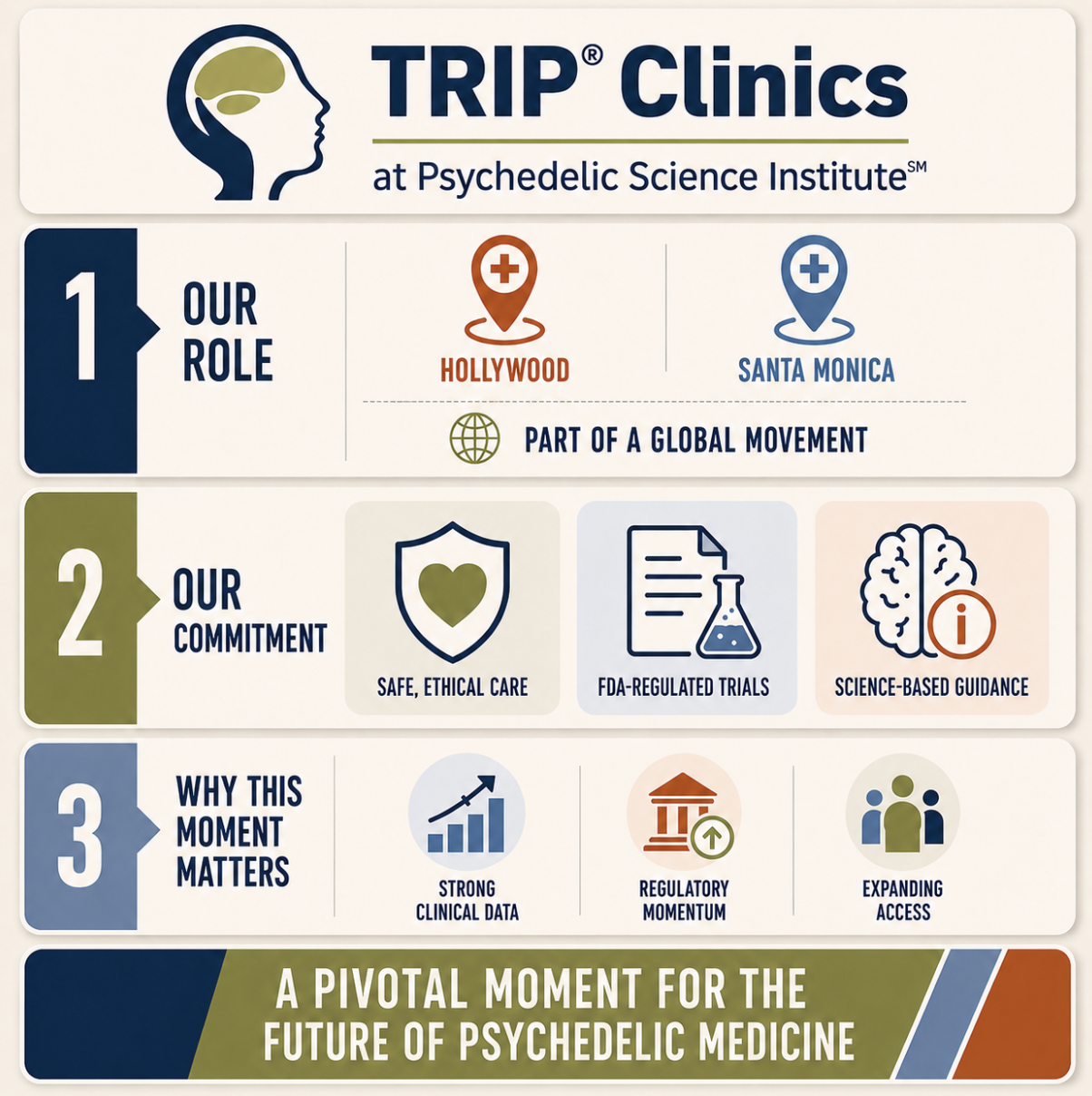
The PSI team believes the delivery of psychedelic medicine will evolve toward such Centers of Excellence grounded in neuroscience, interventional psychiatry, and a multidisciplinary team-based approach. Our TRIP Clinics are designed to deliver psychedelic medicines — both approved and investigational — and are planning to soon integrate complementary services such as Spravato® (intranasal esketamine) and Transcranial Magnetic Stimulation (TMS), both FDA-approved for treatment-resistant depression.
Our PSI team has participated in more than a dozen psychedelic clinical trials involving psilocybin, LSD, MDMA, DMT, and related compounds, while delivering more than 11,000 ketamine-assisted therapy sessions. This combination of clinical trial expertise and real-world care delivery positions PSI uniquely at the intersection of research and scalable implementation.
Over time, psychedelic medicine centers will hopefully evolve from, or partner with, healthcare systems. Such centers will likely be best equipped to integrate care delivery, clinical trials, outcomes research, and practitioner training, while coordinating services across the broader healthcare ecosystem beyond behavioral health, including neurology, oncology, women's health, primary care, and rehabilitation.
The reimbursement question
Despite this new momentum spurred by the executive order, one of the largest unanswered questions remains reimbursement: how will patients be covered, and how will providers and healthcare systems be paid. While FDA approval could accelerate insurance coverage over time, reimbursement models for psychedelic-assisted therapies are still being defined. We believe value-based and other innovative payment approaches may ultimately play an important role, but the field will need to collaboratively establish care models, demonstrate outcomes, and articulate the broader value proposition of these treatments while ensuring reimbursement adequately reflects the full cost and complexity of care delivery.
Frequently asked questions
What did the April 2026 executive order do for psychedelic medicine?
The order directed the FDA to use existing expedited review pathways, including breakthrough therapy designation, to accelerate development of psychedelic-assisted therapies. It also authorized $50 million in federal research funding, signaled intent to reconsider Schedule I status for psychedelics following successful trials, and enabled expanded pre-approval patient access through the Right to Try Act.
When might psilocybin receive FDA approval?
Approval is not guaranteed and depends on Phase 3 trial data. If Compass Pathways and Usona Institute submit compelling NDAs for psilocybin in treatment-resistant depression and major depressive disorder respectively, approval could occur within the next 12–18 months. No timeline is certain.
Will MDMA be approved for PTSD?
Resilient Pharmaceutical (previously Lykos) received a Complete Response Letter from the FDA in August 2024. Approval will depend on their ability to fully address the FDA’s outstanding concerns with additional data. No approval date has been publicly confirmed.
Can patients access psychedelic therapies now?
Currently, ketamine-assisted psychotherapy (KAP) is the only FDA-approved psychedelic medicine available in clinical settings in CA. PSI’s TRIP Clinics in Hollywood and Santa Monica offer KAP, psychedelic integration, and clinical trial participation for qualifying patients. Access to investigational therapies like psilocybin remains limited to approved clinical trial settings.
What makes PSI’s TRIP Clinics different?
PSI is a research-driven clinical organization with more than 30 years of leadership experience in psychedelic medicine. Our TRIP Clinics have served as enrolling sites for more than 15 clinical trials and have supported over 11,000 ketamine-assisted therapy sessions. We are developing our clinics as specialized Centers of Excellence for both investigational and future FDA-approved psychedelic medicines.
Conclusions
We are at a pivotal and optimistic time in the field of psychedelic medicine, interventional psychiatry, and the broader behavioral neurosciences. Clinical trial data to date increasingly suggests that psychedelics are powerful therapeutic tools for many historically difficult-to-treat conditions. The challenge is building the clinical infrastructure, practitioner training programs, safety standards, and integrated healthcare systems capable of delivering psychedelic therapies responsibly and at scale. PSI and its TRIP Clinics are committed to helping build that future.
Learn more
Support the Psychedelic Integration Fund: psychedelicsci.com/pif
.png)